

If you ride horses long enough, inevitably, you will have a fall. That’s why every equestrian learns early in their riding career that when you fall off, you get right back on. So, when I found myself unceremoniously dismounted from the horse I was riding on Thanksgiving day, my old trainer’s words came flooding back to me.
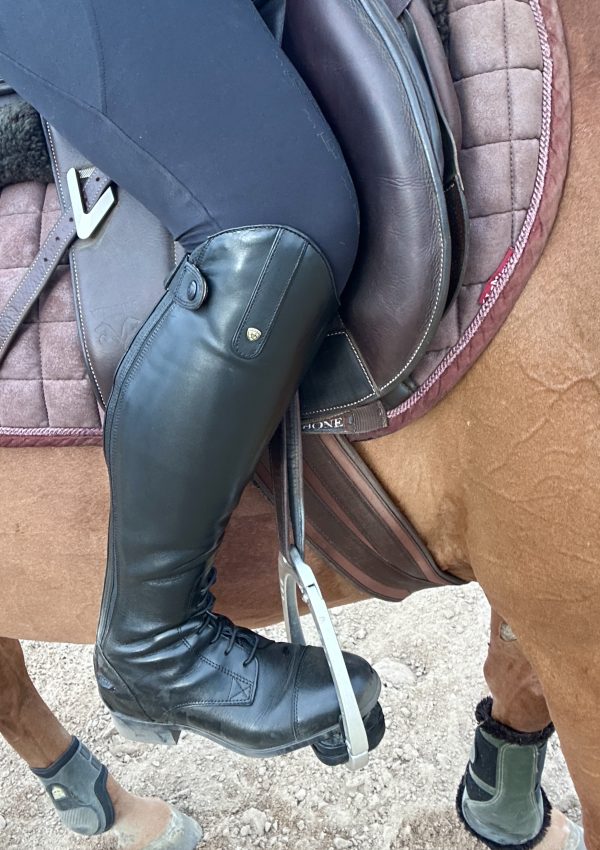
Horses are nothing, if not unpredictable (which is what makes riding in the winter even more exciting). This year, I decided to spend a quiet Thanksgiving at the barn and looked forward to wearing my new riding apparel from Thiandro Equestrian. It was a rainy Thursday, so I braced myself to deal with a horse that might think he was a fire-breathing dragon and prepared to brave the indoor arena (it’s always fun when the rain on a canvas roof is amplified). I had done this many times before and was undeterred by being alone at the barn. After decades of riding, I consider myself a good judge of what is dangerous versus what is just risky. This felt like the latter.
I’ve been riding the same horse for about two years, and I like to think that I know his personality well. There had been days when I could tell just by looking at him that it wasn’t the right day for a ride, but this didn’t feel like one of those days. He was slightly antsy while I was tacking him up, but after all, most of the horses were stuck in their stalls due to the weather. I thought a light ride might be good for him and help calm him down a bit.
We walked down to the indoor without incident, and he seemed happy to be outside. However, once inside the indoor arena, with the cement base and the wind blowing along the canvas dome, my horse’s mood shifted. I had seen this before, especially when we were the only ones in the riding ring. I brought him to the mounting block and put my foot in the stirrups. Once mounted, it felt like there was 1,500 pounds of dynamite ready to explode underneath me. We walked a few tight circles near the front of the indoor, allowing him to look outside and see that no threats were approaching. I talked to him, and he began to soften and relax.
Then he saw it—a dark wet spot on one of the concrete blocks from where the roof had been dripping. He stopped dead in his tracks and spooked, and before I could react, I felt my body tumble and graze the left side of his neck as I made my way to the ground. I managed to hold onto the reins but then dropped them as I fell backward. Fortunately, he stood there in shock and then trotted to the closed door of the indoor, awaiting my arrival. Neither horse nor rider was hurt, which mattered most to me at that moment. But the shock of falling off, even though I broke my fall with my own two feet, was unnerving.
We stood silently staring at each other as if the past few minutes couldn’t be undone. I wasn’t angry, and the horse looked remorseful. I returned to the mounting block for a second time, but it was clear that no ride would happen that day. I dismounted (on my own terms this time), and we returned to the barn to untack.
I’ve never underestimated the ability of a horse to humble its rider in mere seconds. But in that moment, I was grateful for the bond we shared and our ability to engage in nonverbal communication. As we untacked, both our moods lightened, and the goofy side of this horse that I love so much returned. This incident reminded me of the importance of always listening to your horse (even when they don’t give you subtle clues) and made me thankful for my years of training and ability to remain calm in situations like these.
Despite my seemingly minor fall, falling off in my late thirties feels much more significant than it did when I was in my teens and twenties. Even without enduring significant impact, my neck, back, and arms were sore. But none of that kept me from waking up the next day and heading to the barn for another ride.




Leave a Reply